Swimming in a pool is wonderfully predictable.
The lane is right there.
The black line is right there.
The wall is definitely right there.
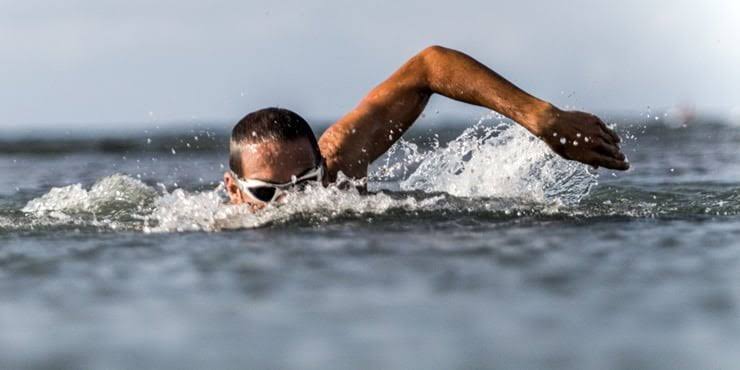
Then you enter open water for the first time and suddenly your beautiful straight-line swimming technique develops a mysterious relationship with chaos.
There are no lane lines.
No giant black line underneath you.
No wall waiting every 25 or 50 metres.
Just water, a distant buoy and the increasingly concerning realisation that you have absolutely no idea whether you're swimming towards it.
Welcome to open-water swimming.
One of the most important skills to learn is sighting, which means briefly lifting your eyes or head to check where you are going before returning to your normal swimming position.
If you're preparing for an open-water swim or triathlon, learning how to sight efficiently can help you stay on course without completely wrecking your stroke.
And yes, there is a technique to it.
Let's get into it.
What Exactly Is Sighting in Open Water Swimming?
Sighting is simply the act of looking ahead while swimming to check your direction.
In a pool, the lane markings and walls do most of the navigation for you.
In open water, you need to navigate yourself.
You might sight towards a buoy, landmark, shoreline feature or another visible reference point that helps you maintain your intended direction.
The trick is that you don't want to spend half your swim looking forward.
Your goal is to look, orient yourself and get your face back into the water while keeping your stroke as efficient as possible.
Think of it as checking Google Maps while walking.
You glance at the map.
You don't stare at it for the entire journey.
Why Do You Need to Sight?
Because open water has a sneaky little problem:
You can swim really well in completely the wrong direction.
Even experienced swimmers can gradually drift away from their intended line because of currents, waves, wind, breathing patterns or simple changes in body position.
You may think you're swimming directly towards a buoy.
Then you look up.
The buoy is suspiciously no longer in front of you.
It is now somewhere over there.
Excellent.
Sighting helps you correct your direction before a small deviation becomes a giant detour.
And in a triathlon, those extra metres aren't exactly free.
The Basic Sighting Technique
Let's keep the first version simple.
While swimming freestyle, slightly lift your eyes and look forward for a brief moment.
You don't need to dramatically lift your entire head out of the water.
In fact, lifting your head too high can cause your hips and legs to drop, increasing drag and making swimming harder.
Think eyes first, minimal head movement.
Take a quick look at your target.
Then return your face to the water and continue swimming normally.
The movement should feel like a small interruption rather than a complete reset of your stroke.
At first, it may feel awkward.
That's normal.
You're asking your body to perform a movement it isn't used to performing.
Don't Turn Sighting Into Breaststroke
This is where beginners sometimes get carried away.
They see the buoy.
They want to make absolutely certain it still exists.
So they lift their entire head and chest out of the water.
Suddenly their beautiful freestyle becomes something resembling a confused version of breaststroke.
Your head comes up.
Your hips sink.
Your legs drop.
Your body creates more drag.
And now you're working much harder.
The goal is not to get a panoramic view of the ocean.
You just need enough information to confirm:
“Yep. Still going that way.”
Then get your face back down.
How Often Should You Sight?
There isn't one magic number that works for every swimmer or every open-water environment.
How frequently you need to sight depends on factors such as visibility, conditions, your swimming ability, the course and how straight you naturally swim.
If you're swimming in calm, clear water with an obvious target, you may not need to sight as frequently.
If conditions are choppy or visibility is poor, you may need to check your direction more often.
A useful approach is to practise sighting at regular intervals during training rather than waiting until you realise you've drifted massively off course.
The more confident you become, the less disruptive the movement should feel.
Try the “Sighting + Breathing” Technique
One of the most useful skills for triathletes is combining sighting with your normal breathing rhythm.
Instead of lifting your head completely separately from everything else, you can learn to coordinate the movement with your stroke.
For example, you might briefly sight forward and then turn your head to the side for your normal breath.
The exact sequence can vary depending on your stroke and what feels natural.
The objective is simple:
See where you're going without destroying your rhythm.
This takes practice.
And the first few attempts may look and feel absolutely nothing like the elegant open-water swimming videos you've watched.
That's okay.
Skill first.
Grace later.
What Should You Look At?
In a race, the obvious answer is usually the next buoy.
But depending on the course and conditions, you may also use larger landmarks to help maintain your direction.
A building.
A distinctive tree.
A structure.
A shoreline feature.
Something large and easy to identify.
This can be particularly useful when the next buoy is difficult to see because of waves, swimmers or glare.
Instead of constantly hunting for a tiny floating object, use bigger visual references whenever they are available.
Sighting in Crowded Races Is Different
Open-water triathlon starts can be chaotic.
Lots of swimmers.
Lots of splashing.
Lots of arms.
Lots of people who have suddenly forgotten the concept of personal space.
In a crowded swim, your view of the course may be blocked by other athletes.
That makes sighting even more important.
You may need to look for the buoy when you have a clearer view, or use larger landmarks to help maintain your general direction.
It's also worth practising swimming around other people before race day if you can.
Because swimming alone in a calm pool and swimming surrounded by 100 enthusiastic triathletes are, technically, two different experiences.
What About Waves?
Sighting becomes more challenging when the water is choppy.
Waves can make it difficult to see your target, and lifting your head at exactly the wrong moment can make you swallow half the water you're swimming through.
In choppy conditions, timing matters.
You may need to wait for a better moment to sight rather than trying to force the movement against every wave.
And remember: your sighting doesn't need to be perfect.
You are gathering enough information to maintain direction.
You're not trying to conduct a full underwater navigation survey.
Practise Sighting Before Race Day
This is the biggest takeaway.
Don't make race day your first sighting session.
Sighting is a skill.
And skills improve through repetition.
You can practise during pool sessions by introducing short sighting drills into your freestyle.
For example, practise lifting your eyes briefly every few strokes while trying to maintain your body position and rhythm.
If you're able to train in a safe, suitable open-water environment, practise there too.
Learn what it feels like to sight in real conditions.
Practise finding landmarks.
Practise swimming towards a target.
Practise when you're slightly tired.
Because race day will not politely pause while you figure it out.
Sighting Is Also a Great Reason to Get Coaching
Swimming technique can be difficult to evaluate on your own.
You might think you're lifting your head slightly.
Your coach might watch you and immediately say:
“My friend, your entire upper body just left the water.”
And that feedback can be incredibly useful.
A coach can help you work on body position, stroke efficiency, breathing and sighting technique, while also helping you understand how these skills fit into your wider triathlon training.
If you're preparing for your first triathlon, this kind of guidance can remove a lot of the guesswork.
Next Lap also provides training plans and training camps for athletes who want more structure and guidance while preparing for their next endurance challenge.
Because sometimes the fastest way to improve a skill is simply having someone experienced tell you what you're doing wrong.
Preferably before you swim 500 metres in the wrong direction.
Common Sighting Mistakes to Avoid
The biggest mistake is lifting your head too high.
The second is sighting so frequently that your normal stroke rhythm disappears.
Another common issue is only looking directly at the water immediately in front of you rather than learning to identify useful landmarks further ahead.
And perhaps the most obvious mistake of all:
Never practising it before race day.
You wouldn't wait until marathon morning to learn how to tie your running shoes.
Don't wait until your first open-water triathlon to figure out how to navigate.
The Goal Is Efficient Navigation
Good sighting should eventually feel almost boring.
That's a compliment.
You swim.
You sight.
You adjust.
You keep swimming.
Your stroke doesn't fall apart.
Your breathing stays controlled.
You don't lose your rhythm.
And most importantly, you keep moving in the direction you actually intended to go.
That's the skill you're trying to build.
Not the ability to lift your head dramatically out of the water while looking extremely determined.
Ready to Take Your Swimming Beyond the Pool?
Open-water swimming can feel intimidating at first.
But once you learn the basics of navigation, sighting, breathing and adapting to the environment, it becomes a completely different experience.
And if you're training for a triathlon, these skills can make your swim feel much more controlled and race-ready.
So practise your sighting.
Learn your landmarks.
Keep the head movement small.
Stay relaxed.
And don't wait until race day to discover that your idea of “straight” and the buoy's idea of “straight” are two very different things.
Build the skill during training.
Then show up on race day knowing exactly where you're going.
Because in open water, swimming fast is great.
Swimming fast in the right direction is even better.
Team Next Lap
Contributing author at Next Lap